
"Jamaican Frost Coffee"
200 article(s) found

Coffee Culture: coffee knowledge Literacy
Classification of coffee: coffee, small evergreen trees or shrubs, rubiaceae, long ovate leaves, pointed front, white flowers, berries, crimson, with two semilunar seeds together, and some oval seeds fried into powder, which can be used as a beverage, exciting and cheap stomach, produced in tropical and subtropical regions. In terms of varieties, there are mainly two kinds: a

53 coffee producing areas in the world
Seven. Haiti's Good Coffee from Politically Troubled Land Despite its well-known problems and fluctuating coffee quality, Haiti is still trying to produce some quality coffee. Most of the coffee produced in Haiti is grown in a purely natural state, not intentionally but as a result of material shortages, because farmers are too poor to buy
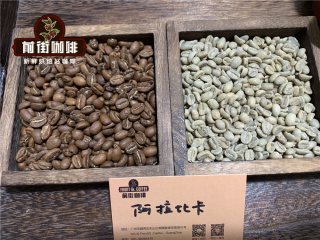
Arabica Flavor characteristics explain what Arabica variety is | what are the characteristics of Arabica coffee beans
Professional coffee knowledge exchange more coffee bean information please follow the coffee workshop (Wechat official account cafe_style) Arabica bean is one of the three major beans of coffee, accounting for 70% of the coffee consumption market, and is also one of the highest consumption coffee beans in the world. The reason why Arabica can become a coffee bean.

Main producing areas and characteristics of coffee
Coffee production zones (commonly known as coffee belts) range from 25 degrees north latitude to 30 degrees south latitude, covering many countries in Central, West Africa, the Middle East and South Asia, the Pacific, Latin America and the Caribbean. The reason why coffee cultivation is concentrated in this area is mainly due to the limitation of temperature. Because coffee trees are vulnerable to frost, neither north nor south latitude is suitable, especially in the tropics.

Main producing areas and characteristics of Fine Coffee
Coffee production zones (commonly known as coffee belts) range from 25 degrees north latitude to 30 degrees south latitude, covering many countries in Central, West Africa, the Middle East and South Asia, the Pacific, Latin America and the Caribbean. The reason why coffee cultivation is concentrated in this area is mainly due to the limitation of temperature. Because coffee trees are vulnerable to frost, neither north nor south latitude is suitable, especially in the tropics.
15 kinds of fancy iced coffee
1. Iced latte 1. Fill the glass with five minutes of ice and add 10 grams of syrup. 2. Pour the fresh milk into the cup until it is seven minutes full, then stir well so that the syrup is melted into the fresh milk to increase the proportion of fresh milk. 3. Let the coffee slowly pour into the cup along the back of the spoon, not too fast, so as not to destroy the sense of hierarchy. 4. Add two more tablespoons of milk foam. two
Production of 15 kinds of fancy iced coffee
1. Iced latte 1. Fill the glass with five minutes of ice and add 10 grams of syrup. 2. Pour the fresh milk into the cup until it is seven minutes full, then stir well so that the syrup is melted into the fresh milk to increase the proportion of fresh milk. 3. Let the coffee slowly pour into the cup along the back of the spoon, not too fast, so as not to destroy the sense of hierarchy. 4. Add two more tablespoons of milk foam.

Fine Honduran coffee tastes delicious the price of Honduran coffee
Overall, Honduran coffee has a good reputation and is suitable for mixed coffee. Coffee in Honduras is imported from El Salvador. Honduras produces high-acid high-quality coffee. Like other places, the coffee grade in Honduras depends on altitude: coffee grown at 700 to 1000 meters above sea level is medium, and grown at 1000 to 1500 meters above sea level

What are the features of coffee machines in well-known coffee estates?
Honduras Generally speaking, Honduran coffee has a good reputation and is suitable for blended coffee. Coffee in Honduras was imported from El Salvador. Honduras produces high-acid, high-quality coffee. As elsewhere, coffee grades in Honduras depend on altitude: coffee grown at 700 to 1,000 meters above sea level is medium, and coffee grown at 1,000 to 150 meters above sea level is medium.

Main producing areas and characteristics of Coffee in the World
Coffee production zones (commonly known as coffee belts) range from 25 degrees north latitude to 30 degrees south latitude, covering many countries in Central, West Africa, the Middle East and South Asia, the Pacific, Latin America and the Caribbean. The reason why coffee cultivation is concentrated in this area is mainly due to the limitation of temperature. Because coffee trees are vulnerable to frost, neither north nor south latitude is suitable, especially in the tropics.
The main producing areas and characteristics of Coffee in the World
Coffee production zones (commonly known as coffee belts) range from 25 degrees north latitude to 30 degrees south latitude, covering many countries in Central, West Africa, the Middle East and South Asia, the Pacific, Latin America and the Caribbean. The reason why coffee cultivation is concentrated in this area is mainly due to the limitation of temperature. Because coffee trees are vulnerable to frost, neither north nor south latitude is suitable, especially in the tropics.

Basic knowledge of coffee in main producing areas and characteristics of coffee
Coffee production zones (commonly known as coffee belts) range from 25 degrees north latitude to 30 degrees south latitude, covering many countries in Central, West Africa, the Middle East and South Asia, the Pacific, Latin America and the Caribbean. The reason why coffee cultivation is concentrated in this area is mainly due to the limitation of temperature. Because coffee trees are vulnerable to frost, neither north nor south latitude is suitable, especially in the tropics.

Fine Coffee the main producing areas and characteristics of coffee in the world
Coffee production zones (commonly known as coffee belts) range from 25 degrees north latitude to 30 degrees south latitude, covering many countries in Central, West Africa, the Middle East and South Asia, the Pacific, Latin America and the Caribbean. The reason why coffee cultivation is concentrated in this area is mainly due to the limitation of temperature. Because coffee trees are vulnerable to frost, neither north nor south latitude is suitable, especially in the tropics.
Key points of coffee making 15 kinds of fancy iced coffee
1. Iced latte 1. Fill the glass with five minutes of ice and add 10 grams of syrup. 2. Pour the fresh milk into the cup until it is seven minutes full, then stir well so that the syrup is melted into the fresh milk to increase the proportion of fresh milk. 3. Let the coffee slowly pour into the cup along the back of the spoon, not too fast, so as not to destroy the sense of hierarchy. 4. Add two more tablespoons of milk foam.
Coffee production key points of 15 kinds of fancy iced coffee
1. Iced latte 1. Fill the glass with five minutes of ice and add 10 grams of syrup. 2. Pour the fresh milk into the cup until it is seven minutes full, then stir well so that the syrup is melted into the fresh milk to increase the proportion of fresh milk. 3. Let the coffee slowly pour into the cup along the back of the spoon, not too fast, so as not to destroy the sense of hierarchy. 4. Add two more tablespoons of milk foam.

Introduction to the Flavor and taste of Arabica Coffee in China
Arabica coffee accounts for 70% of all coffee production, and Arabica coffee accounts for 70% of all coffee products. its excellent flavor and aroma make it a direct drinkable coffee with only 8 Arabica beans (8). But its resistance to dryness, frost, diseases and insect pests is too low, especially the natural enemy of coffee-leaf rust, so all producing countries are in

The key points of making 15 kinds of fancy iced coffee
1. Iced latte 1. Fill the glass with five minutes of ice and add 10 grams of syrup. 2. Pour the fresh milk into the cup until it is seven minutes full, then stir well so that the syrup is melted into the fresh milk to increase the proportion of fresh milk. 3. Let the coffee slowly pour into the cup along the back of the spoon, not too fast, so as not to destroy the sense of hierarchy. 4. Add two more tablespoons of milk foam.

The species of Arabica beans, the classification of Arabica beans, coffee beans, Arabica.
Variety editor native species in all coffee production, Arabica coffee accounts for 70% of the coffee 80%, its excellent flavor and aroma make it the only coffee that can be drunk directly. However, its resistance to dryness, frost, diseases and insect pests is too low, especially the natural enemy of coffee-leaf rust, so all producing countries are committed to variety improvement.

15 kinds of fancy iced coffee making key points fancy coffee making
1. Iced latte 1. Fill the glass with five minutes of ice and add 10 grams of syrup. 2. Pour the fresh milk into the cup until it is seven minutes full, then stir well so that the syrup is melted into the fresh milk to increase the proportion of fresh milk. 3. Let the coffee slowly pour into the cup along the back of the spoon, not too fast, so as not to destroy the sense of hierarchy. 4. Add two more tablespoons of milk foam.
Coffee making in Cafe key points for making 15 kinds of fancy iced coffee
1. Iced latte 1. Fill the glass with five minutes of ice and add 10 grams of syrup. 2. Pour the fresh milk into the cup until it is seven minutes full, then stir well so that the syrup is melted into the fresh milk to increase the proportion of fresh milk. 3. Let the coffee slowly pour into the cup along the back of the spoon, not too fast, so as not to destroy the sense of hierarchy. 4. Add two more tablespoons of milk foam.